Getting Started
Start strong by building a solid foundation in understanding and then speaking Arabic. Our immersive method surrounds you in language you understand – without relying on translation or pressure to memorize.

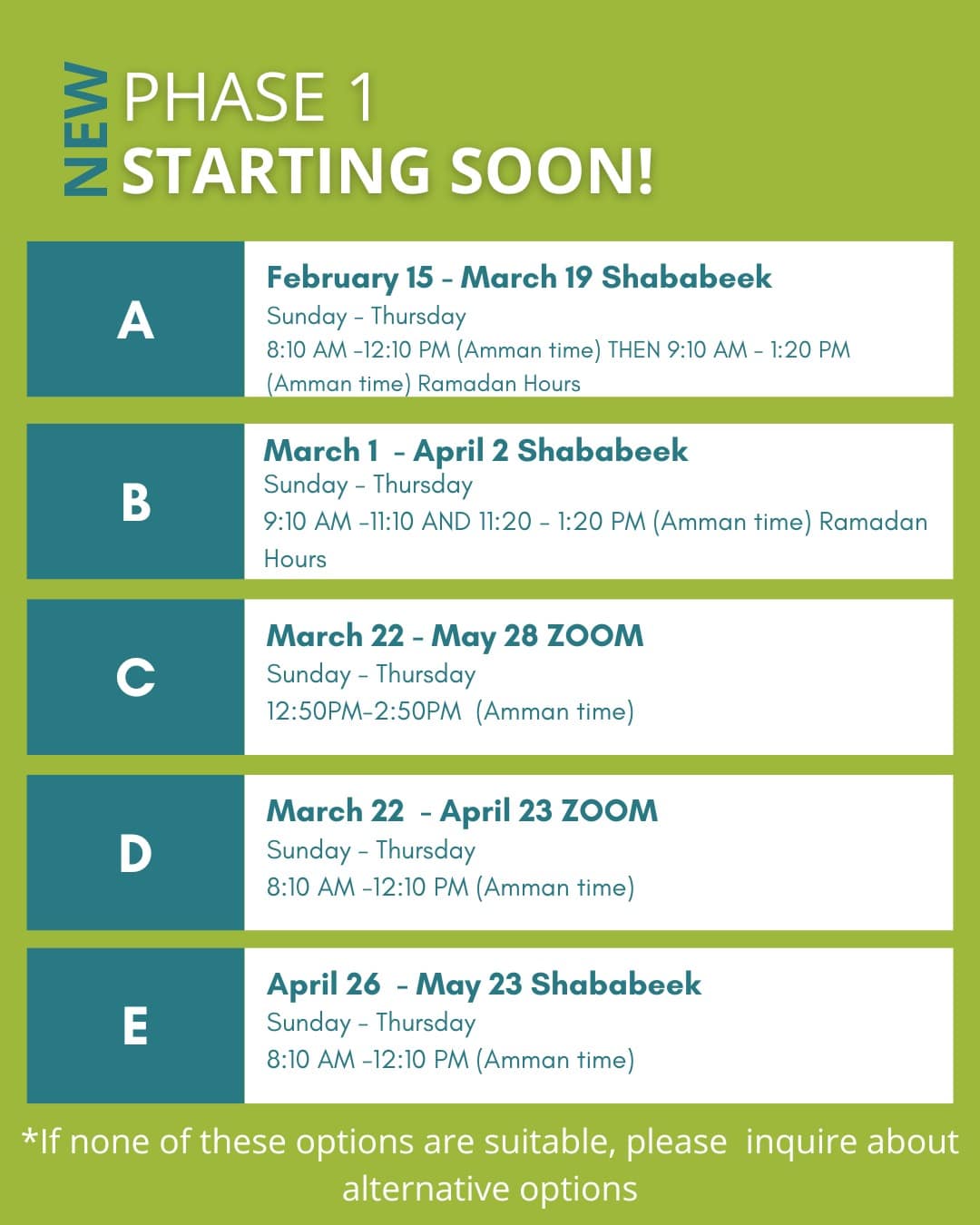
Winter 2026 Schedule:
New cohorts are forming now for the winter season. Whether you are starting from scratch or looking to build a strong foundation, our small group setting offers the perfect mix of community and immersion.
Follow a guided curriculum designed for beginners to rapidly develop core speaking and listening skills.
Learn alongside others, practice real exchanges, and benefit from the repetition that a group setting provides.
Gain essential cultural context that helps you understand how Levantine Arabic is spoken in daily life.
By focusing on familiarity with vocabulary and the new sounds of Arabic before requiring you to speak, you can ease into the process by strengthening your comprehensive skills first.
Our structured sequential approach to beginning Levantine Arabic starts with building understanding, then speaking, then reading and writing (in further phases). This allows you to focus on one layer of the Arabic learning process at a time, freeing you to let foundations solidify before moving on to the next stage of learning. Although this happens in a relatively short period, this sequence allows your brain space and energy to absorb one competency at a time.

Many programs have you “study Arabic” by attempting to learn language through your eyes. Shababeek’s program for beginning Levantine Arabic will help you learn Arabic through your ears – just as you did your first language – by seeing and hearing and then doing and imitating. In this way your speech will become instinctive, as you learn how to speak by hearing Arabic speakers use their language.
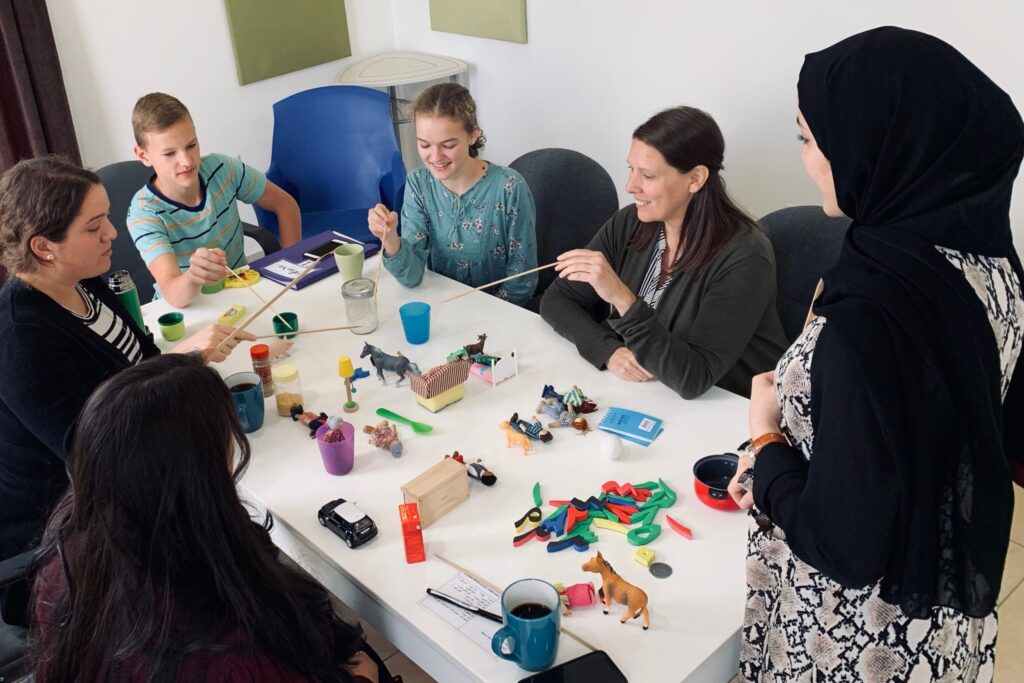
To approach learning Arabic as an academic undertaking is stressful and boring. Language acquisition should be relational and practical, focused on building skills for interaction.
By making the language learning process interactive, physically engaging and built around key functions, you can take the strain out learning Arabic.
When beginning Levantine Arabic, your primary “homework” will be listening to recordings made for you in each session in order to soak yourself in high frequency Arabic vocabulary and adjust to new sounds.

We don’t just rely on casual conversation partners. Our curriculum is built on a robust, six-phase framework (approx. 1600 hours) designed to take you from absolute beginner to full fluency.
Every session is intentional. We use a "comprehension-led" approach, carefully sequencing lessons to train your ears and build a "sound foundation" before we ever ask you to speak.
You are never learning alone. Between our experienced Language Coaches and dedicated Progress Managers, you get personal guidance to keep you motivated and "unstuck."
We maximize your brain’s energy by focusing on one competency at a time. By prioritizing listening over reading in the early stages, we help you absorb the language faster and more naturally.
When choosing a Levantine Arabic program, it’s important to know what is helpful, and what isn’t.
Arabic conversation partners are an excellent way to practice what you have learned, and build deeper relationships. In later Arabic learning phases, you find many people who will converse with you in Arabic. However, this is not the most efficient way to begin learning Arabic. If you are serious about learning Arabic well, the language program you choose should be structured and facilitated by language coaches who are experienced in supporting Arabic learners.
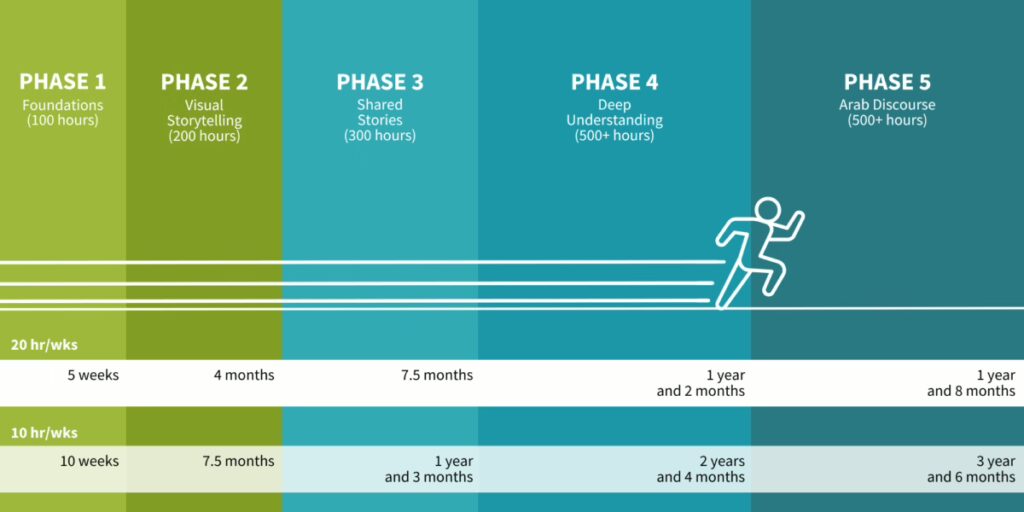
Shababeek’s proven Arabic program is exactly that: a structured path to fluency. It’s divided up into six phases – approximately 1600 hours of structured lessons.
The beginning Levantine Arabic phase is the “foundations” phase. This is where your core understanding of colloquial Arabic is built. Each lesson intentionally reinforces key vocabulary alongside important linguistic concepts.
In the early phase of language development, you spent time listening to adults speak before being forced to to produce speech yourself. In Phase 1, we offer a shortened version of that stress free time so that you can focus purely on listening and absorbing all the new sounds and vocabulary before you are asked to begin producing your own sentences. Our approach to learning Levantine Arabic is comprehension led; first you must hear Arabic speech you understand in order to eventually feel like something “sounds right.”
That’s how it works in your native language, isn’t it? You don’t need to be able to name grammatical rules or ace grammar tests in order to know if a sentence is correct or not. It either sounds right, or it doesn’t. A comprehension led Arabic program can produce similar results. You need not be worried about memorizing grammar charts in order to properly form Arabic sentences. You’ll do it because your brain is being trained to comprehend a new language and language structure. This is one of the reasons why we refer to people learning Arabic with us as “participants,” rather than “students.” We want everyone to be regularly reminded that the goal of learning colloquial Arabic is to participate in life and human relationships, not just study a language.
Language doesn’t exist in a self-contained sphere divorced from culture. They are inseparably intertwined. The program you choose to begin learning Arabic should focus not only on the Arabic language, but on Arab culture. You need to know a lot about the people who use the language and how to interact with them in respectful and winsome ways.
For example, after you are beginning to learn Levantine Arabic, you will quickly come across the words for bread, garbage can, and the verb to throw away. Your teacher or language coach may offer the cultural advice to never throw bread in the garbage in Jordan. Why might that be? Where you’re from, you might not think much about throwing bread away, particularly if it has become hard or moldy. But in Jordan, if you throw bread in the garbage that action says something. It says you have a low regard for the gifts of God. Bread is a tangible manifestation of God’s grace. If someone is seen throwing bread away, however well intentioned they are, it will say something about their character. Whether you choose to study Levantine Arabic with Shababeek or somewhere else, your Arabic program should include cultural insights such as this so that you can avoid offending local people.
Shababeek does not offer “Arabic conversation partners.” Our Arabic program is exactly that: a program. It’s divided up into six phases of approximately 1600 hours of structured lessons.
The beginning Levantine Arabic phase is the “foundations” phase. This is where your foundation for colloquial Arabic is built, so it is important that each lesson is planned out.
When you think about the early phase of language development, you spent some time listening to adults speak before you had to produce speech yourself. In Phase 1, we’ll give you a shortened version of that stress free time so that you can focus purely on listening and absorbing all the new sounds and vocabulary before you are asked to begin producing your own sentences. Our approach to learning Levantine Arabic is comprehension led; first you must hear Arabic speech you understand in order to eventually feel like something “sounds right.”
That’s how it works in your native language, isn’t it? You don’t need to be able to name grammatical rules or ace grammar tests in order to know if a sentence is correct or not. It either sounds right, or it doesn’t. A comprehension led Arabic program can produce similar results. You need not be worried about memorizing grammar charts in order to properly form Arabic sentences. You’ll do it because your brain is being trained to comprehend a new language and language structure. This is one of the reasons why we refer to people learning Arabic with us as “participants,” rather than “students.” We want everyone to be regularly reminded that the goal of learning colloquial Arabic is to participate in life and human relationships, not just study a language.
Language doesn’t exist in a self-contained sphere divorced from culture. They are inseparably intertwined. The program you choose to begin learning Arabic should focus not only on the Arabic language, but on Arab culture. You need to know a lot about the people who use the language and how to interact with them in respectful and winsome ways.
For example, after you are beginning to learn Levantine Arabic, you will quickly come across the words for bread, garbage can, and the verb to throw away. Your teacher or language coach may offer the cultural advice to never throw bread in the garbage in Jordan. Why might that be? Where you’re from, you might not think much about throwing bread away, particularly if it has become hard or moldy. But in Jordan, if you throw bread in the garbage that action says something. It says you have a low regard for the gifts of God. Bread is a tangible manifestation of God’s grace. If someone is seen throwing bread away, however well intentioned they are, it will say something about their character. Whether you choose to study Levantine Arabic with Shababeek or somewhere else, your Arabic program should include cultural insights such as this so that you can avoid offending local people.
People who begin studying Levantine Arabic come from a variety of backgrounds. Most are starting from ground zero, not knowing a single word in Arabic. Others who begin to study āmmiyya Arabic (the Levantine word for the colloquial dialect) may already know how to read and write quite well. Some have studied MSA, but still need phase 1 to transition to the local dialect. For these reasons, and because it’s more important to train your ears before your eyes, we recommend Arabic learners don’t focus too intently on learning the alphabet in depth during phase 1. That should be saved for phase 2, where a language coach can give more attention (or less) to this skill. If you already read and write well, make sure you inform your support staff before going into phase 2 as it may shave off some time for you.
Personal attention to your individual growth is part of your program, so take advantage of our experienced Arabic learning coaches. All challenges we take on in life are improved with a coach’s support.
In addition, each learner at Shababeek is assigned a Manager of Participant Progress who is keeping an eye on your advancement. This is particularly important in Phases 2-5 in order to coordinate with our team the ideal time for you to transition from one sub phase to another. Advancement managers are tracking each individual’s progress to help our Arabic learners achieve their goals.
Even though the lessons are completely immersive in Arabic, you will have the support of a language learning advisor outside of sessions. Our experienced team has helped thousands of Arabic learners achieve high proficiency in our program.
Each of our staff also have a dedicated Employee Support Manager. This person observes and oversees Arabic sessions from time to time to offer training or support when needed.
Move beyond the textbooks. Start your journey toward authentic conversations and real cultural connection with our immersion-led approach.