In this episode of our podcast Jennifer addresses how to use اللي (illi) in Levantine Arabic. She covers 4 ways it is used, and 4 common mistakes that Arabic learners make.
Using اللي (illi) properly will take your Arabic speaking skills to the next level. Read (or listen) on to learn how.
(The above episode contains recordings from native Arabic speakers. Make sure you listen to how they use اللي.)
If you’ve been learning spoken Levantine Arabic for a while, you’ve probably noticed something:
Native speakers constantly use the word اللي.
And if you’re not using it — or you’re using it incorrectly — your Arabic can sound incomplete and more foreign, even if everything else you say is correct.
In this episode of Tips for Learning Levantine Arabic, we break down how اللي (illi) functions in spoken Levantine Arabic, why it is essential, and the most common mistakes learners make. (We’ll also stop transliterating it in this post as by now you’re recognizing the word in the Arabic script.)
Unlike English, where words like “that” can sometimes be omitted, in many sentences اللي is not optional. It plays a crucial role in sentence structure and clarity.
Let’s go deeper into how it works, as well as mistakes Arabic learners often make when trying to use it.
In everyday Levantine Arabic, اللي functions as a relative pronoun. It specifies which person, place, or thing we are referring to.
In English we can say: “The boy that is over there is my son” or “The boy over there is my son.” There is no real difference in meaning. However, in spoken Arabic, you must include اللي in this kind of structure. It is not superfluous. It is essential. Let’s see why.
These are the main ways اللي functions. If you get these down, you’re well on your way to improving your speaking ability. But remember, it’s not about memorizing grammar. It’s about noticing the patterns of speech, and practicing it over and over.
We use اللي to clarify which object or person we mean.
Here are a few examples:
If the clause contains a verb, اللي goes before the verb and the noun must be referenced again with a pronoun.
This is a mistake many Arabic learners make. Remember, you must use the pronoun to refer back to the noun.
For example:
In English this feels redundant. In spoken Levantine Arabic, it is required.
This is one of the most common structural differences that marks someone as an intermediate versus advanced speaker.
When اللي is used at the beginning of a sentence, that’s a clue that a general statement is being made.
Here are some examples of اللي being used in a general statement:
In this usage, اللي functions like an ungendered pronoun — referring to any person in general who does such things.
You can use اللي to emphasize who performed an action.
Here’s the structure these sentences follow:
Person/Pronoun + اللي + verb
These examples will help clarify. Notice where اللي is placed in the sentence:
This construction adds emphasis and confirmation to who did the action.
اللي can also appear in questions when you want specificity. It will often follow question words, like: شو، مين، وين، متى.
Here’s how it works in questions:
The difference is subtle for Arabic learners to catch — but native speakers use it constantly.
It’s also important to know how اللي is not used. These can be hard for Arabic learners to catch on their own if someone isn’t actively correcting them. After working with hundreds of Levantine Arabic students, we repeatedly see these patterns. As you go over these, check your own speech to see if you are making these mistakes.
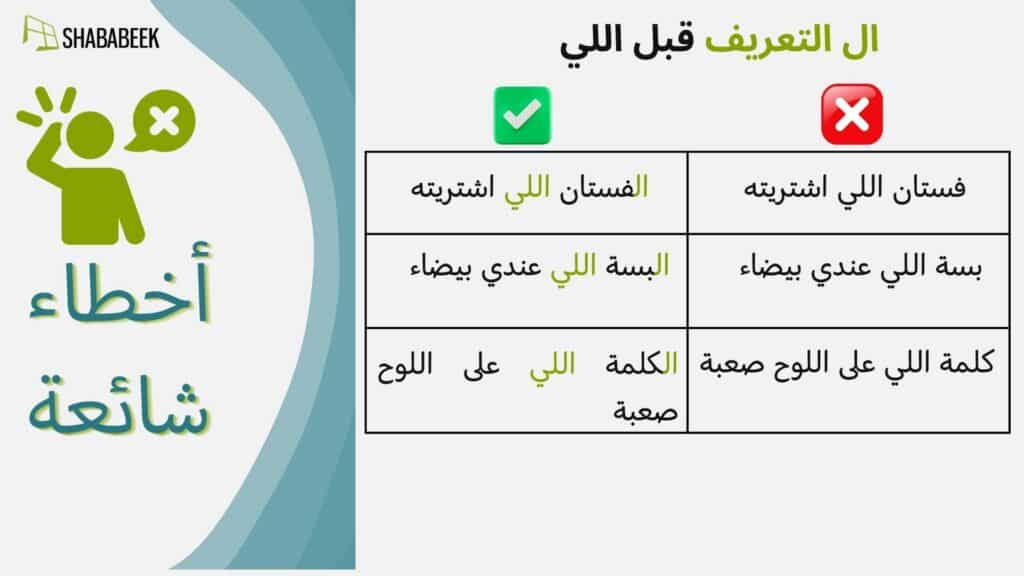
When using اللي, the noun must be definite; you have to add ال.
Note how ال is used in the following examples:
If the noun is not definite, the structure breaks down. Here’s a graphic we made for our grammar workshop. Note if you are making any of the below mistakes.
Learners often try to say something like,
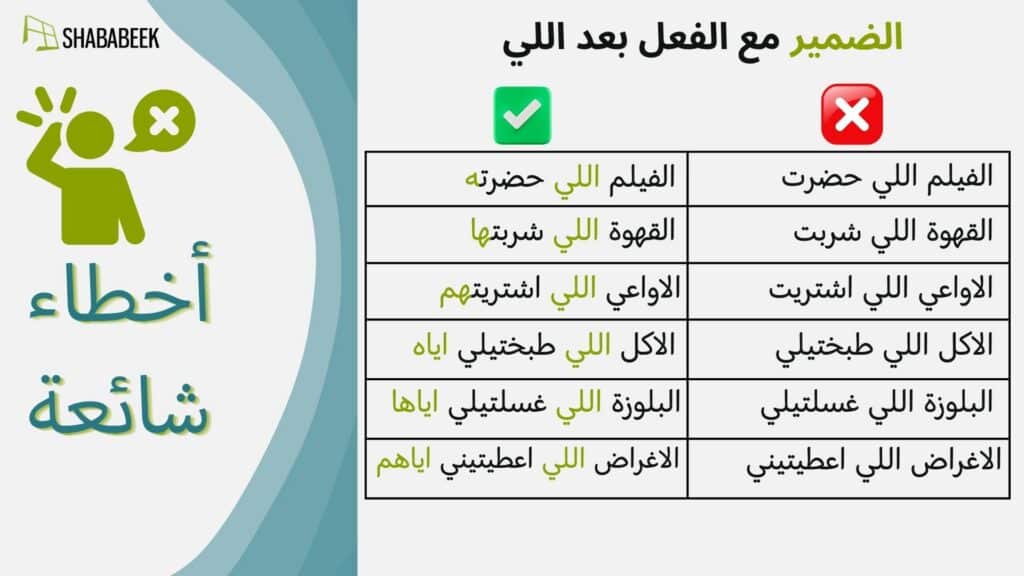
“The movie that I watched”
by saying,
“الفيلم اللي حضرت”
Notice how they dropped off the pronoun after the verb?
Don’t forget to include the attached pronoun in Arabic.
In spoken Levantine Arabic, you must repeat it.
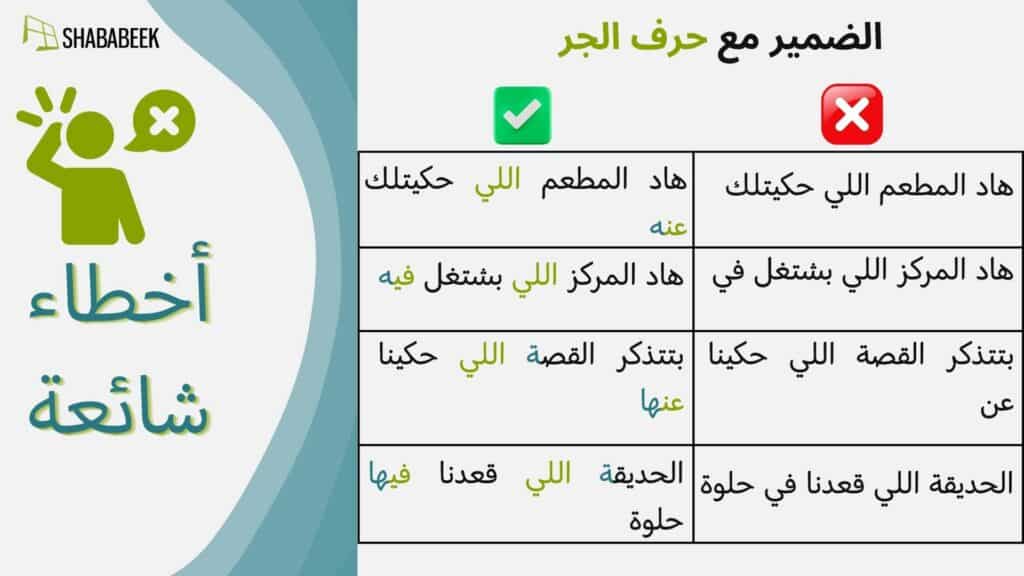
This repetition is not optional. Below are a few more examples of mistakes we commonly see, and how to correct them.
If the verb requires a preposition (like “in,” “about,” or “with”), it must be included — and the pronoun must attach to it.
Here are a few examples of this:
Leaving out the preposition makes the sentence incomplete.
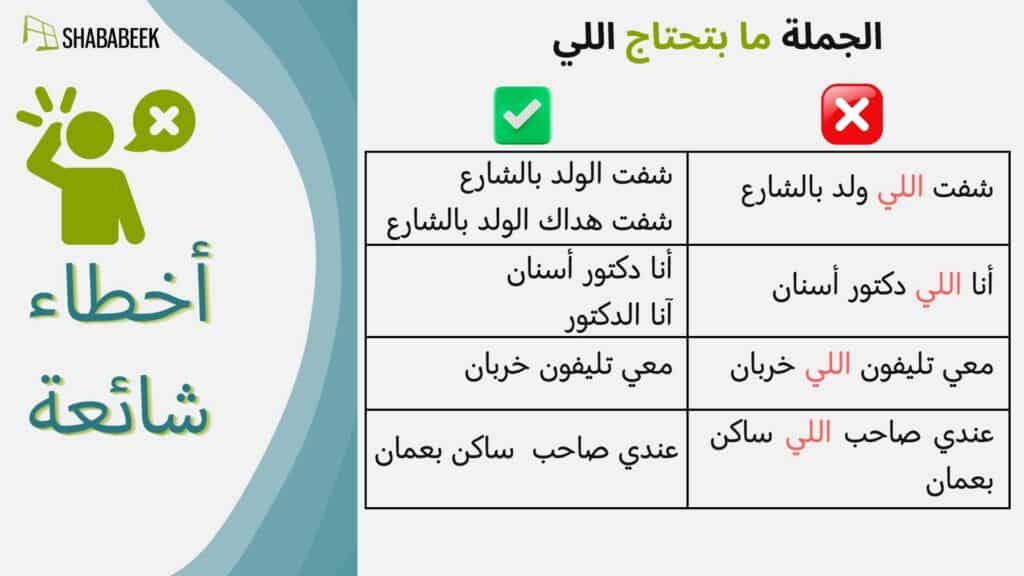
Sometimes learners insert اللي unnecessarily, especially when translating directly from English.
Here are a few examples of adding اللي to sentences where it doesn’t belong:
“I saw that boy in the street.”
You do not need اللي in this sentence.
Here’s another common mistake:
“My phone that is broken…”
If you are using عندي, you typically do not need اللي.
Overusing it can sound unnatural. Notice the above examples of mistakes listed in the below image. Also notice how they should be stated correctly:
Understanding how اللي works is not about memorizing grammar rules.
Knowing how a violin works does not make you a violinist. Repeated exposure and practice do. Its the same with learning Arabic.
When you use اللي correctly, you sound more natural, your sentences make sense to Arabic speakers, and it is evidence that you are moving from translating your speech from your mother tongue to internalizing how Arabic speakers naturally use the language.
Start noticing every sentence you hear that contains اللي.
Write it down. Record it. Repeat it.
Good language learners are good observers.
Be sure to subscribe to Shababeek’s podcast, where we provide regular content to help you learn Levantine Arabic.