Home » Arabic Learning Tips » Alhamdulillah Meaning (الحمد لله): Why Arabic Speakers Say It Every Day
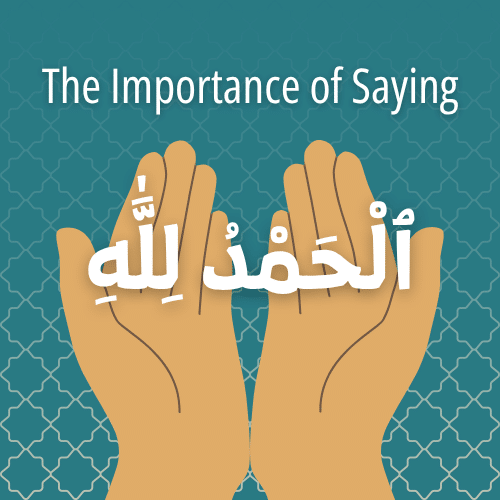
In this episode of our podcast Jennifer responds to an Arabic learner’s question: “why does my friend always say الحمد لله (alhamdulillah), even when things aren’t going well?”
Listen to this episode above (and hear examples given by Arabic speakers), or read along with the edited transcript below.
Language and culture are inseparable. This cannot be emphasized more strongly. It is not enough to learn Arabic words. You need to understand how and why words are used (not only grammatically, but culturally).
There are things you hear every day in Arabic that seem simple on the surface—but carry layers of meaning that aren’t obvious if you didn’t grow up inside the culture.
One of those is the phrase: الحمد لله (alhamdulillah).
Most learners know it means “praise be to God.” But in reality, it communicates much more than that—especially in everyday interactions.
This topic came up when an Arabic learner asked me:
“Why does my Arab friend always say الحمد لله when I ask how he’s doing? I know his life is really difficult right now.”
It’s a fair question.
So I did what I often do (and I encourage others to do as well)—I asked a lot of Arabic speakers the same question. And the more I listened, the more I realized just how much depth is behind this one phrase.
You’ll hear الحمد لله in all kinds of situations:
That last one surprises many learners.
People say الحمد لله after loss, illness, even in the middle of extreme hardship. For many, it’s the first thing said after something like a car accident—before anything else is discussed.
When I asked people about this, many said the same thing:
“It’s automatic.”
“I don’t even think about it.”
“I can’t respond any other way.”
From a young age, people are taught to begin their response with gratitude to God, no matter the situation.
But the reflexive way الحمد لله is used does not diminish the powerful resonance it has with this deep conviction: Everything that happens—good or bad—is from God, and is therefore ultimately good.
Saying الحمد لله is not denying difficulty, it expresses faith and trust. One person told me:
“It reminds me that God is always with me—whether things are good or bad.”
Another said:
“When I say it, I’m affirming that I trust how God is managing my life—even if I don’t understand it.”
What stood out to me most is that many people described the way الحمد لله is used as a kind of spiritual practice.
In this way, using الحمد لله can be formative. It reminds you of what you have, it shifts your attention towards gratitude, it builds your resilience, and it reinforces faith.
As one person put it:
“It makes me better than I was before I said it.”
That’s a powerful claim to make for a single phrase.
If you didn’t grow up within the framework I mentioned above, you might respond to “كيفك؟” (How are you?) by immediately sharing the good and the bad in your life.
That may be natural for some of us who grew up in a different culture—but it can be jarring for many local people. This is where things can get misaligned for Arabic learners.
Many people told me “كيفك؟” is a polite greeting. It is usually not an invitation to share deeply. Those deeper conversations come later, after someone has asked numerous times about various aspects of life. One Arabic speaker told me they don’t share how they’re truly doing with close family until they’ve been asked multiple times.
The expected response to “كيفك؟” is “الحمد لله”. This doesn’t mean that you don’t share the struggles you are currently going through with your Arabic speaking friends. But those struggles are always shared after you have expressed gratitude to God. And, even in the midst of talking to someone about your struggles, الحمدلله is always sprinkled throughout.
This part surprised me.
I asked people directly: “What do you think of someone who doesn’t say الحمد لله?”
Some gave neutral answers, but many didn’t. They said that people who don’t say “الحمد لله” are perceived as negative people, they appear as ungrateful for the blessings they have been given, and they seem spiritually disconnected. In some cases, people told me they would start to avoid talking to people who did not say الحمدلله.
That might sound strong—but it tells you the significant role this phrase plays in communicating who you are.
What appears to be a simple phrase is in fact multi-layered. Not only does saying الحمد لله express your faith in God, it signals gratitude, reflects your worldview, and it shapes how others perceive you. And for many people, the practice of saying الحمد لله actively changes how they experience their own lives.
So as you continue learning Arabic, pay attention not just to what is said—but to what it means within the culture and to individual Arabic speakers. And, don’t forget that you can do this too. When you have cultural questions connected to the Arabic language like the learner we mentioned at the beginning, you can ask ten people what they understand and experience around certain words and phrases. The answers may surprise you, and they will always help you gain a better understanding of Arabic and the people who use it daily.
Be sure to subscribe to Shababeek’s podcast, where we provide regular content to help you learn Levantine Arabic.
Move beyond the textbooks. Start your journey toward authentic conversations and real cultural connection with our immersion-led approach.